Context
Brazil had the answers.
Argentina had the questions.
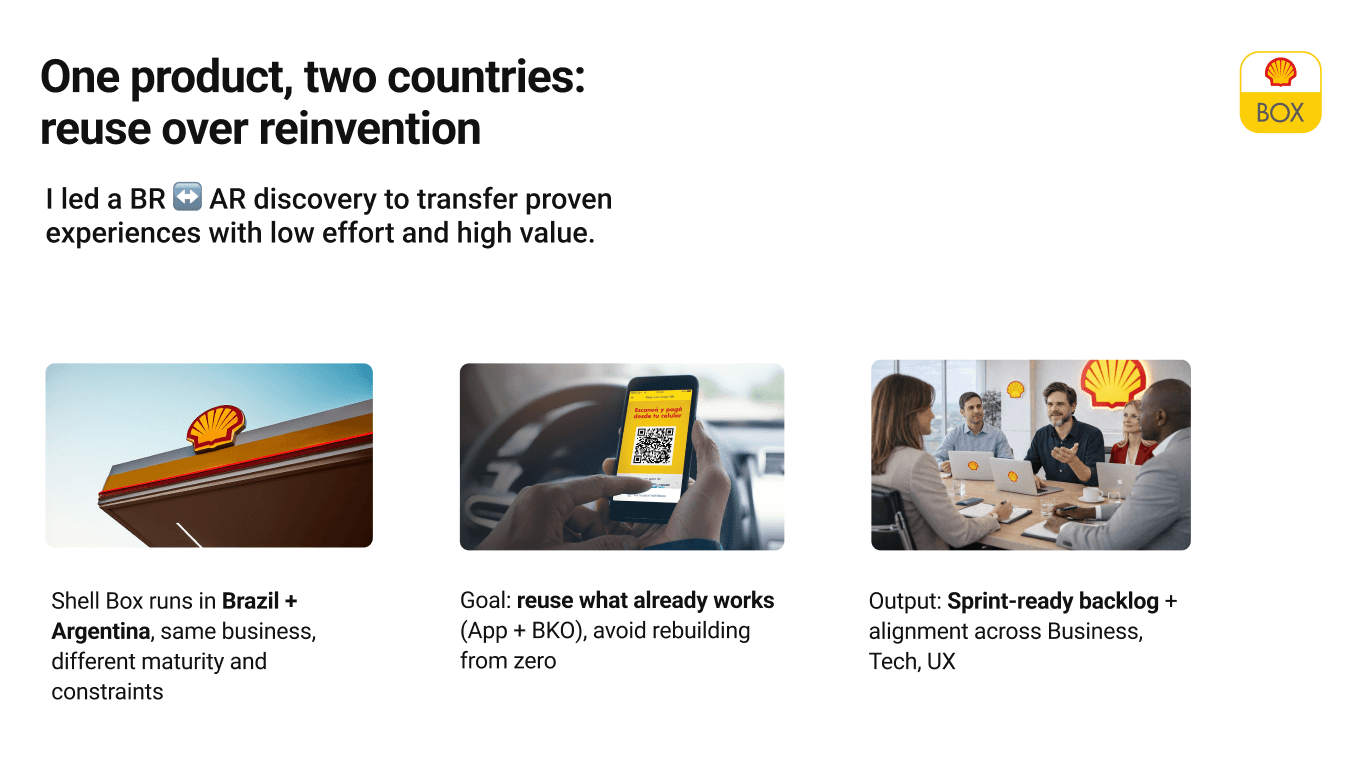
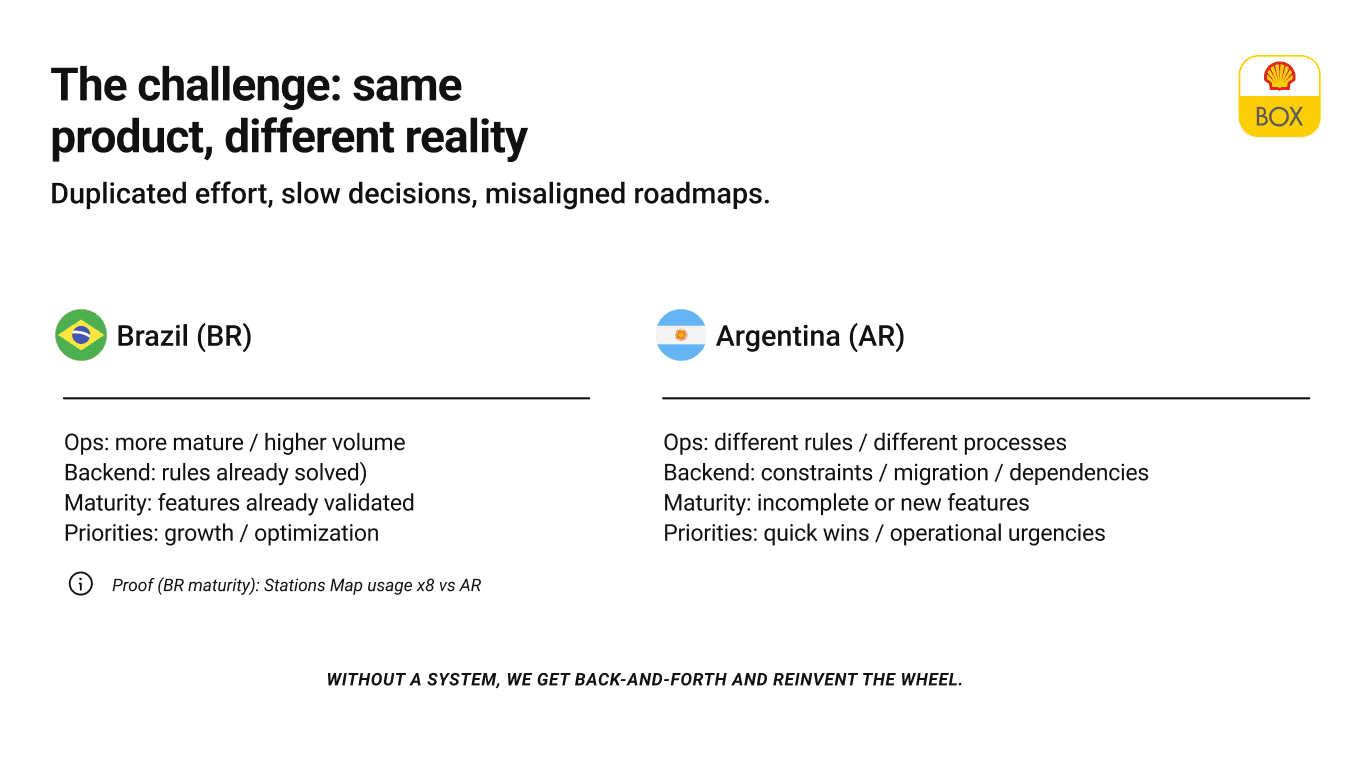
Shell Box Brazil had been live for years. Mature product, proven flows, a design system in production, high feature velocity. They knew what worked.
Shell Box Argentina was earlier stage. Same product challenges, less runway, backend constraints to navigate. Building from scratch would duplicate cost and time.
The opportunity was obvious: reuse Brazil's mature patterns for Argentina. The risk was just as obvious: copy-paste without understanding real market differences would fail. My job was to find where genuine reuse was possible — and where adaptation was genuinely needed.
🇧🇷
Brazil
Mature product. Proven flows. Design system in production. High feature velocity.
🇦🇷
Argentina
Earlier stage. Same product challenges. Less runway. Backend constraints to navigate.
🎯
The real challenge
Find where real reuse was possible — and where adaptation was genuinely needed. Not assumed, verified.
My role
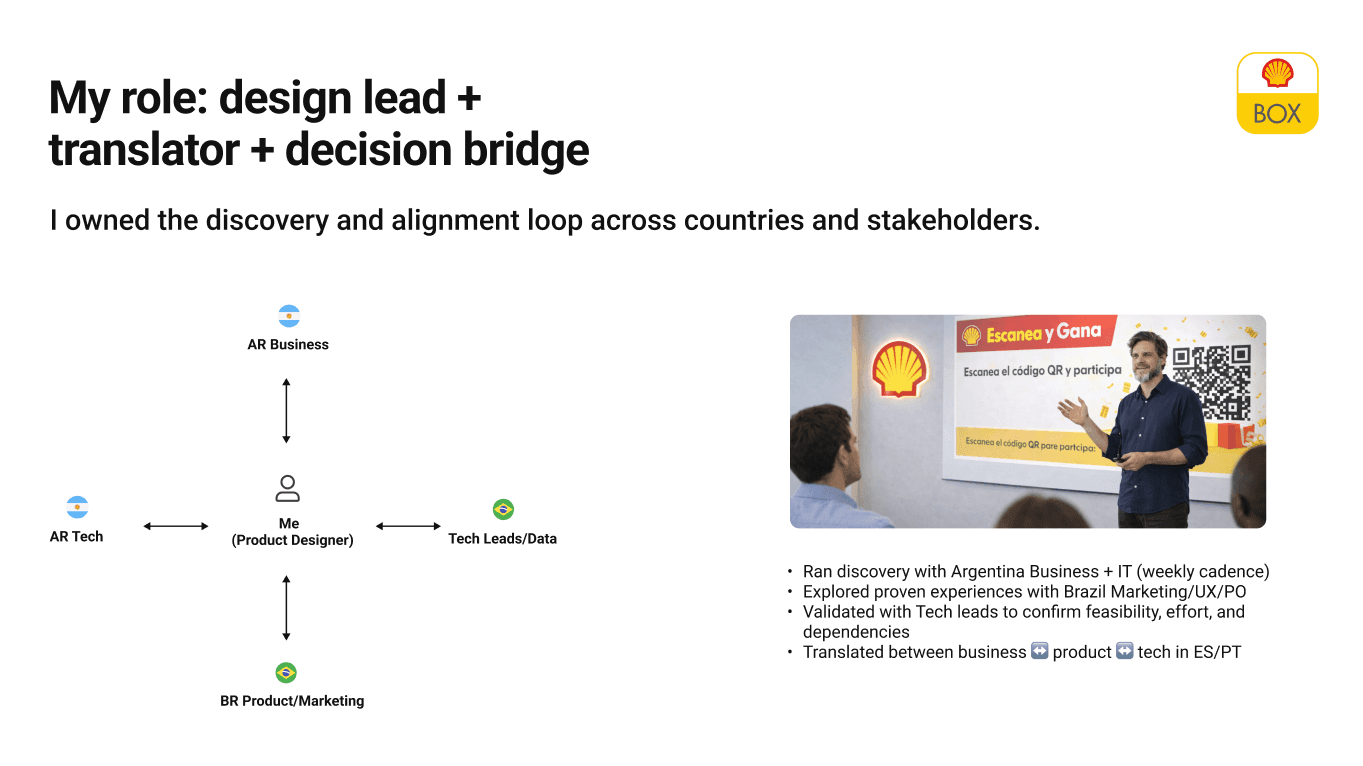
The bridge between
business, tech and UX — in two languages.
I acted as the connective layer between stakeholders in both countries — Product, Engineering, Operations and Business — conducting workshops, synthesizing conflicting priorities and translating insights into decisions that both teams could act on.
Everything ran in Spanish and Portuguese simultaneously.
"If both sides can't trust the output, nothing will ship."
Core principle — bi-national discovery
Approach
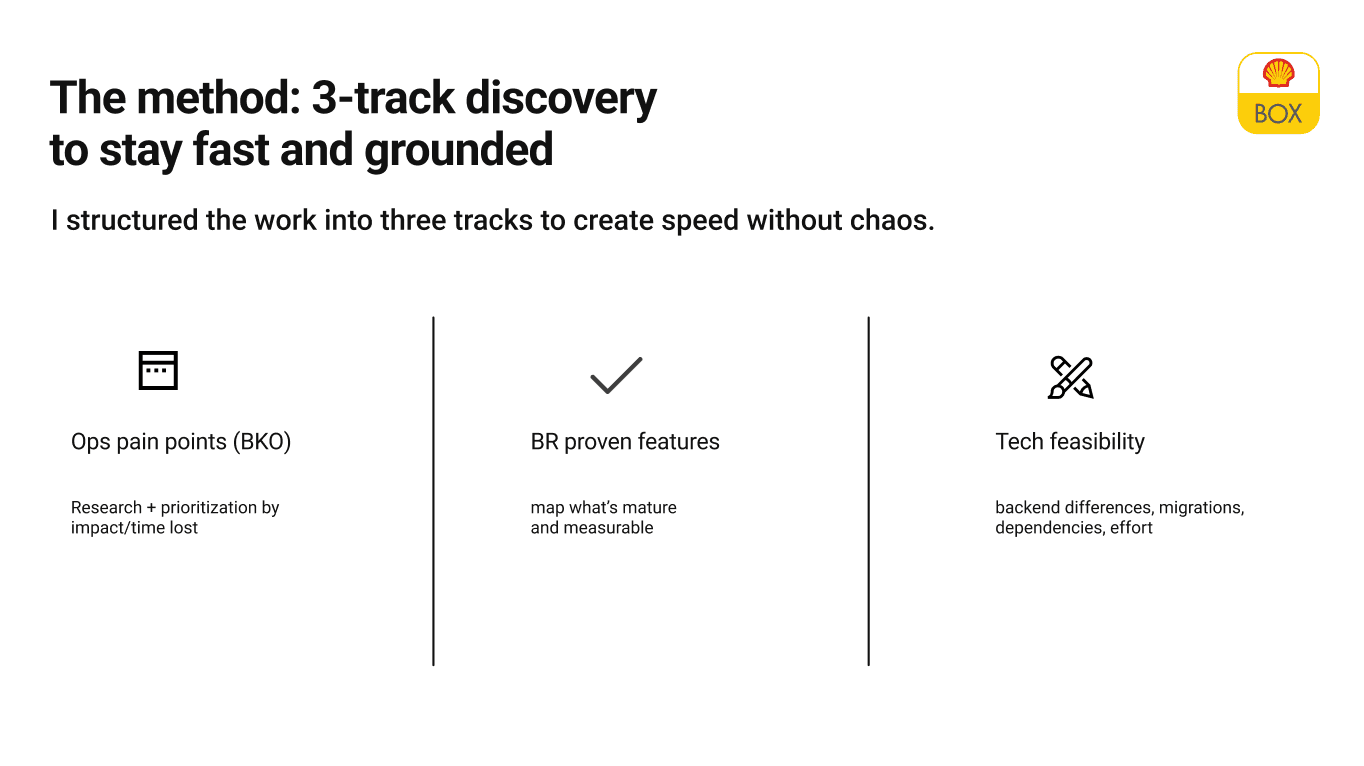
How I ran the discovery.
01
Feature inventory — Brazil
Mapped Shell Box Brazil's existing features and patterns. Identified stable candidates for reuse.
02
Needs mapping — Argentina
Workshops and stakeholder interviews in Argentina. No assumptions from the BR side — documented independently.
03
BR vs AR comparison
Cross-referenced both markets feature by feature. Reuse as-is / adapt / build from scratch. Every decision documented with evidence.
04
Stakeholder alignment workshops
Sessions with leads in both countries. Business, Tech and UX had to agree on the same roadmap.
05
Sprint-ready backlog output
Structured backlog with research evidence, dependency mapping and feasibility notes.
Case documentation · 6 slides
Slide 1
01 — Context and framing
02 — Brazil feature inventory
03 — Argentina needs mapping
04 — Cross-market comparison matrix
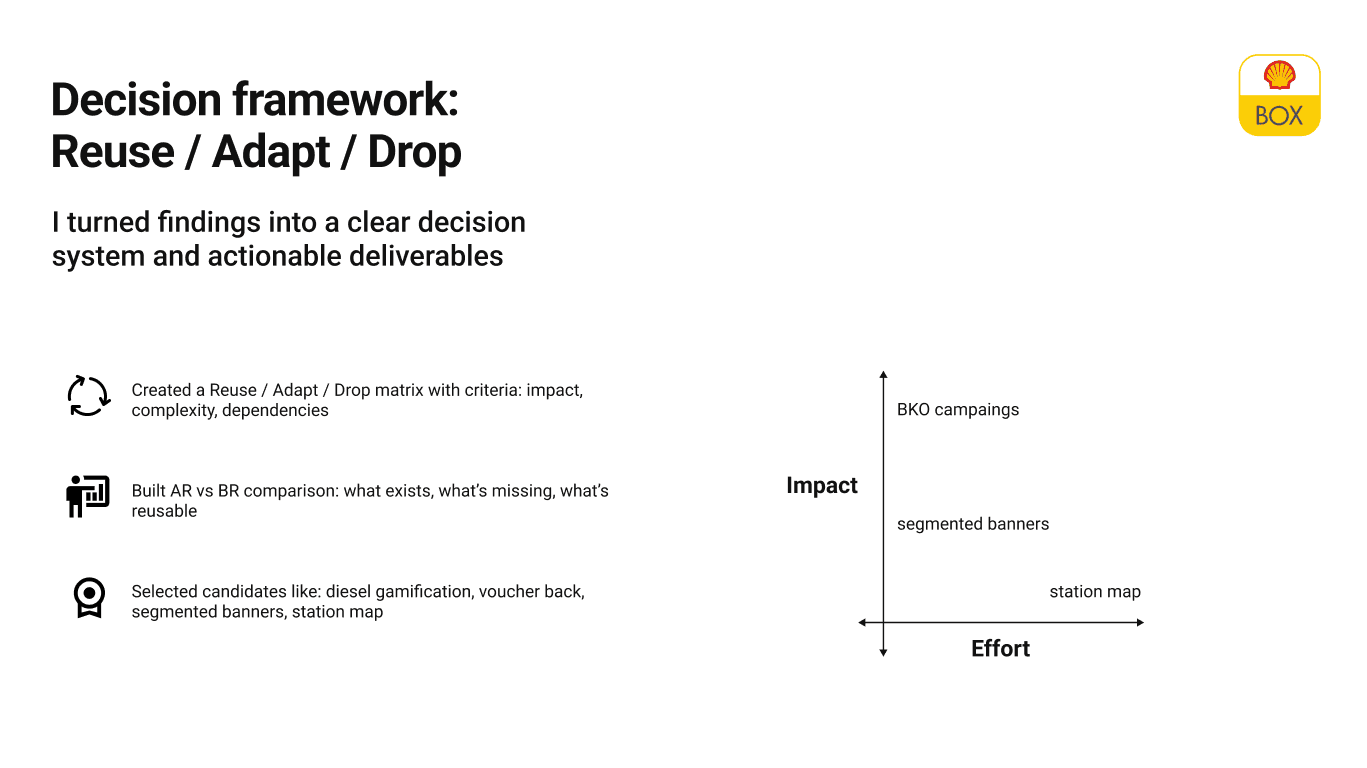
05 — Alignment workshop outcomes
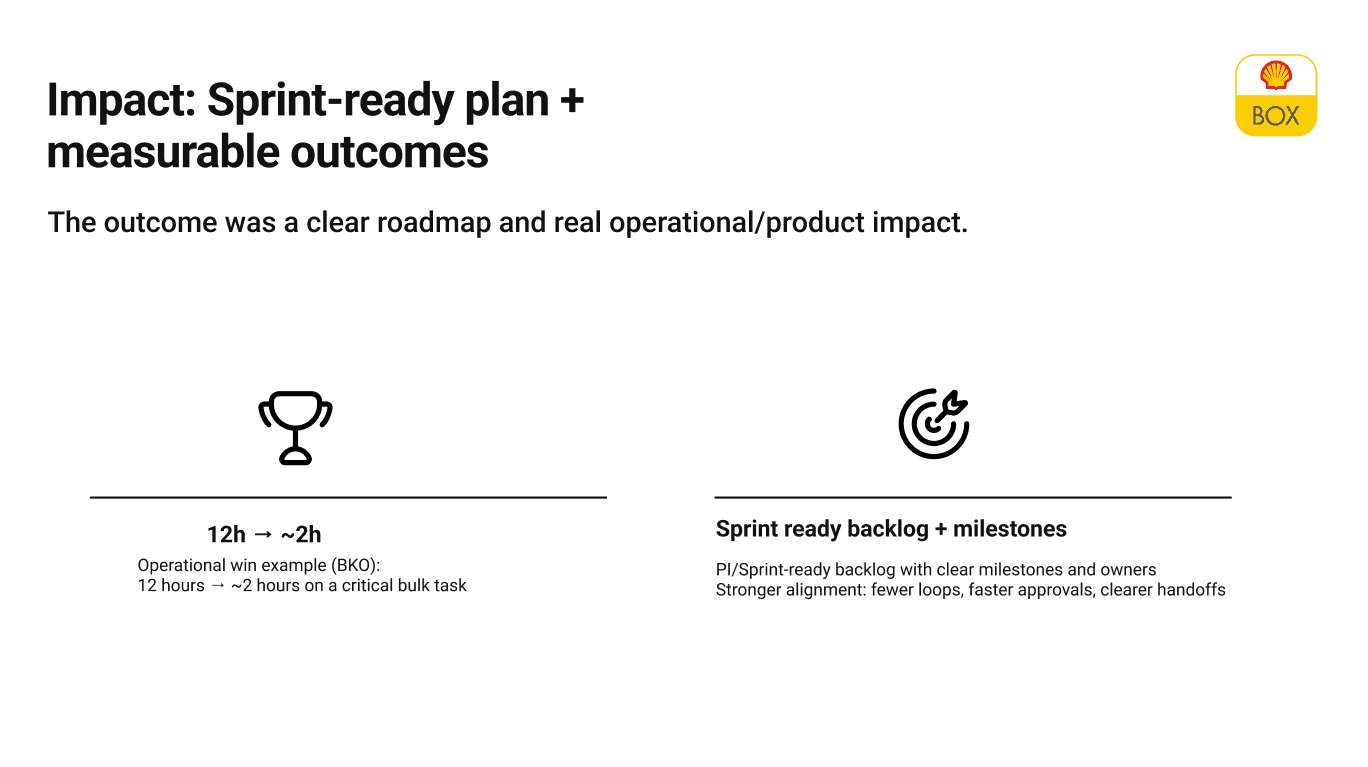
06 — Impact and results
Key challenges
What made this hard.
🔀
Two different backend realities
What worked in Brazil's stack wasn't always feasible in Argentina.
🗣️
Conflicting stakeholder priorities
Business wanted fast delivery. Tech had dependency concerns. Product in Brazil was protective of their roadmap.
📐
Avoiding false equivalences
Similar feature names didn't mean same user need. The discipline was in proving where reuse was genuine.
Output & impact
What teams got at the end.
The primary output was a sprint-ready backlog with documented decisions. Not a strategy deck. Not a vision document. An actionable list of features with research evidence, dependency mapping and feasibility notes that teams could start building from.
Teams stopped asking "why" and started asking "what's next." The shift from skepticism to execution happened because the decisions were documented, justified and agreed across all three functions.
All documentation was bilingual by design. Spanish and Portuguese versions maintained in parallel, not translated after the fact.
PRIMARY OUTPUT
Sprint-ready backlog
Feature decisions with evidence.
ALIGNMENT
Business + Tech + UX
All three functions agreed across both countries.
KEY RESULT
Reuse without copy-paste
Mature Brazil patterns adapted to Argentina's constraints — avoiding full rebuild cost while respecting real market differences.
Reflection
What I learned from this.
Bi-national discovery is a communication and trust problem, not a design problem. The hardest part wasn't mapping features or running workshops. It was building enough trust between two teams in two countries so they'd act on the same backlog.
Running workshops in two languages forced clarity. If you can't explain a design decision clearly in both Spanish and Portuguese, the decision probably isn't clear enough yet. The linguistic constraint became a quality filter.
"If you can't explain a design decision clearly in both languages, the decision probably isn't clear enough yet."
Personal reflection — bi-national discovery
Next case →
From 12 hours to 2 hours:
BKO workflow redesign
Discovery is only half the story. Here's what happened when the insights translated into a real operational redesign.
−83%
Cycle time reduction
Tom Oliva
oliva.tomas@gmail.com
designer-tom.com
Work / One product, two countries
Discovery
Strategy
Shell Box
AR ↔ BR
Stakeholder alignment
One product,
two countries:
one shared vision.
Over several months I led a bi-national discovery between Brazil and Argentina to transfer proven Shell Box experiences — App and Backoffice — and adapt them with low effort and high impact. No reinventing the wheel. Just smart reuse with real market nuance.
SCOPE
BR↔AR
Two markets, one aligned roadmap
OUTPUT
Sprint-ready
Backlog with research evidence and alignment
ROLE
Design lead
Discovery, research, workshops, documentation
LANGUAGES
ES + PT
Aligned cross-country stakeholders in both