Shell Box Argentina · Backoffice · UX/UI Case Study
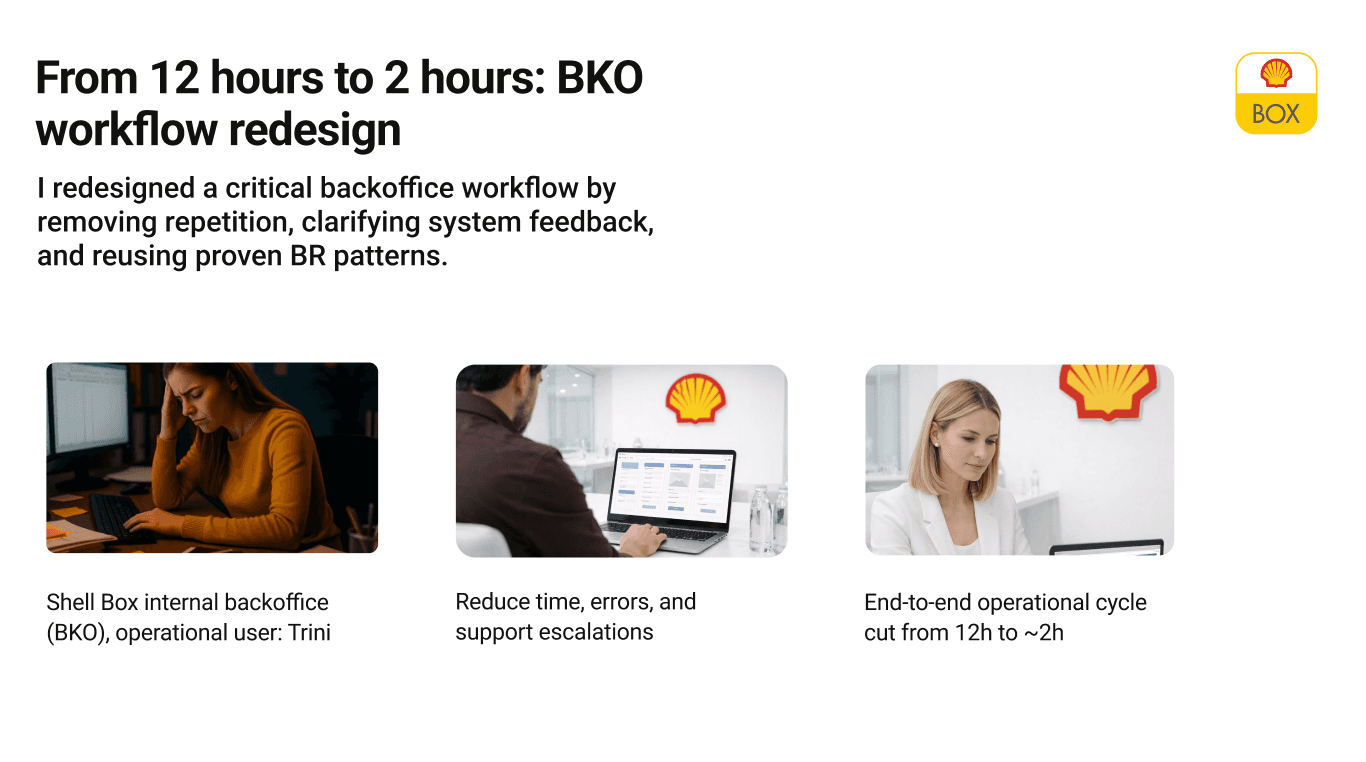
From 12 hours
to 2 hours.
I redesigned a critical Shell Box backoffice workflow around the operator's real way of working, reducing cycle time by 83%.
12h
Before
operational cycle
2h
After
operational cycle
−83%
Reduction
cycle time
Lead
Role
Product Designer

01 — The Problem
A workflow was consuming almost a full workday.
One operational workflow took nearly a full day to complete. The issue was not task complexity, but manual repetition, weak system feedback, rework, and a UI that did not match the operator's real workflow.
BEFORE
✕
Manual inputs one by one
✕
Repeated campaign setup
✕
Weak system feedback
✕
Rework and verification
✕
Low confidence in output
12h
per operation
AFTER
✓
Bulk actions and file upload
✓
Campaigns with recurrence rules
✓
Visible system states
✓
Clear validations
✓
Fewer manual steps
2h
per operation
02 — Research
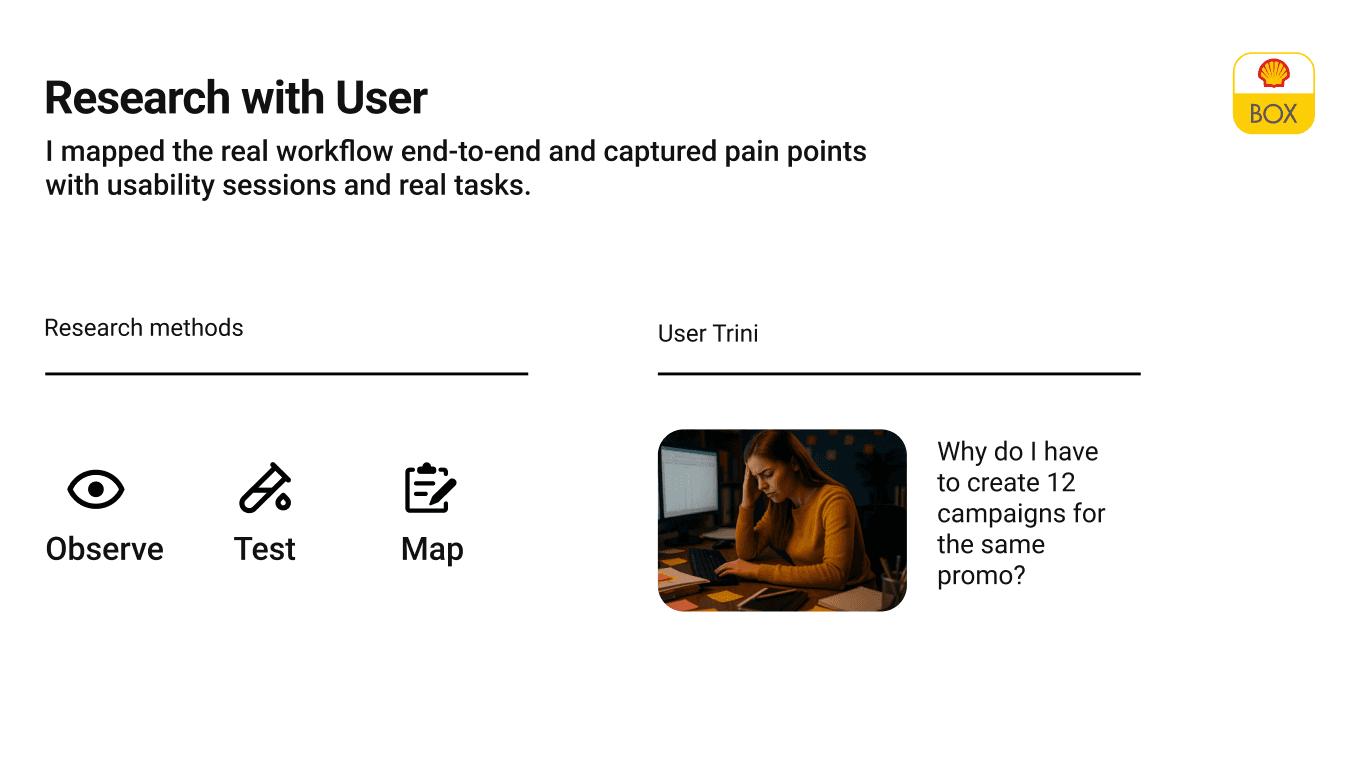
I started by observing the operator at work.
I observed Trini, the main backoffice operator, while she managed promotions and distribution logic in Shell Box. I mapped pain points, identified repetitive work, and tested both the existing workflow and new proposals based on her real operating logic.
01
Direct observation
Watched Trini run the full campaign workflow end-to-end, uninterrupted.
02
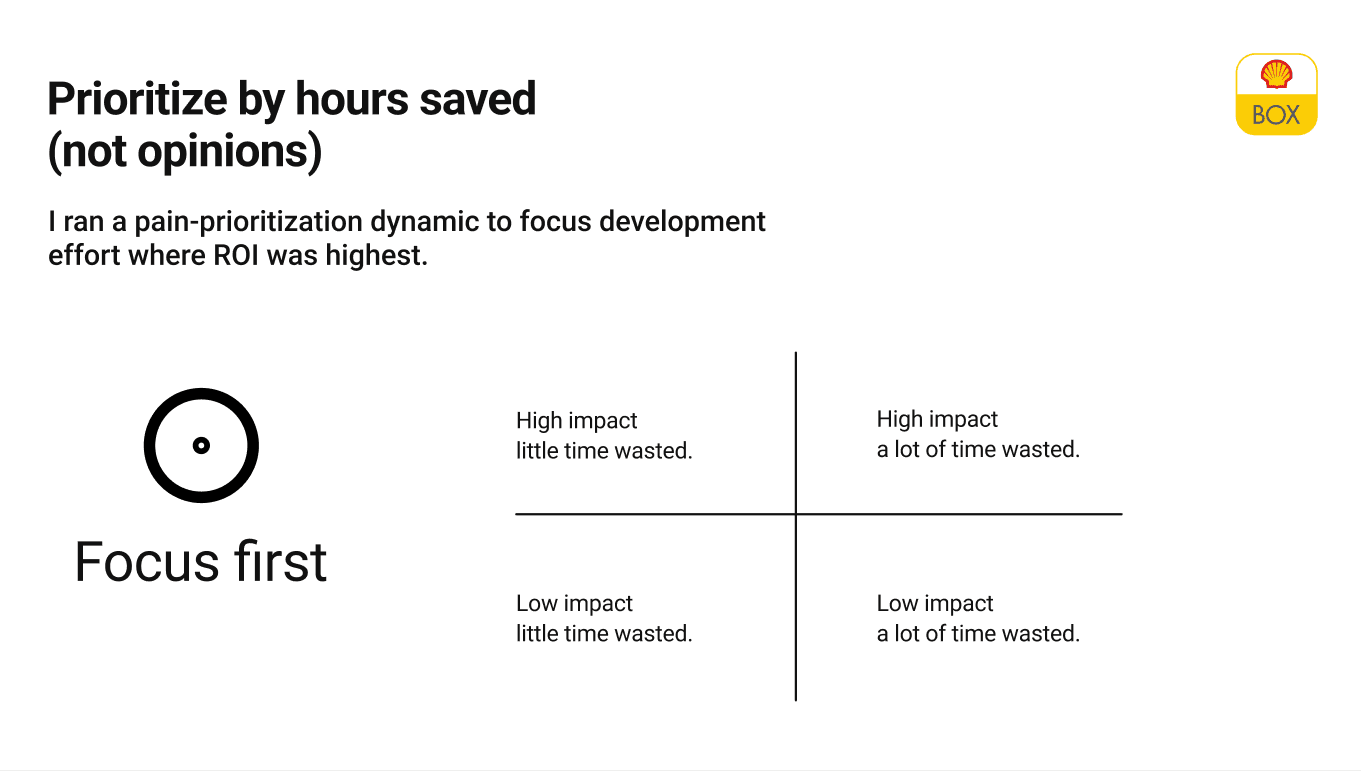
Pain point prioritization
Every friction mapped by impact on time and frequency of occurrence.
03
Usability testing
Both the existing UI and redesign prototypes tested with the actual operator.
"
The operator's workflow became the source of truth for every design decision.
03 — Solution 1
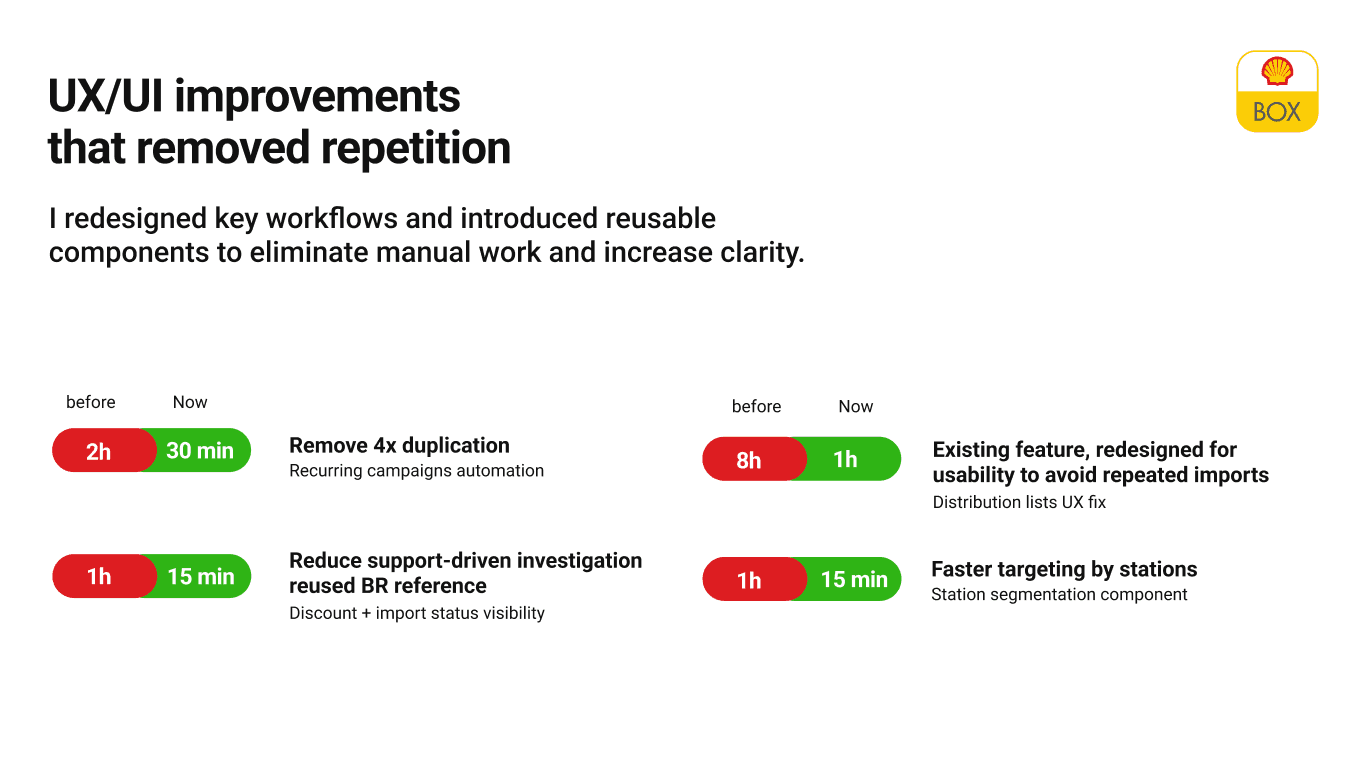
From hundreds of station IDs to one file upload.
Trini had to manually enter or manage hundreds of service stations for each campaign. She was already maintaining the correct station list in Excel, so I redesigned the experience around file upload and bulk selection instead.
BEFORE
Search stations
Enter station ID...
EST-00421 — Palermo
EST-00422 — Recoleta
EST-00423 — Almagro
... 400+ more — repeated per campaign
Add selected
AFTER
Upload Station List
📁
Drop your station file here
Excel or CSV · up to 500 IDs
Select file
✓ estaciones-junio.xlsx · 412 stations loaded · 0 errors
Hundreds of stations → one upload
04 — Solution 2
Why create the same campaign 12 times?
Recurring promotions were being recreated manually again and again. I designed a recurrence flow so one campaign could be configured once and repeated automatically based on rules.
BEFORE
Campaign List
Promo Semanal — Wk 1
Duplicate
Promo Semanal — Wk 2
Duplicate
Promo Semanal — Wk 3
Duplicate
Promo Semanal — Wk 4
Duplicate
... +8 more this month
AFTER
Campaign Configuration
Campaign name
Promo Semanal — Combustible
Start date
01 Jun 2024
End date
31 Dec 2024
Recurrence
Weekly
Monthly
Select days
End date
✓ Will generate 26 occurrences automatically
05 — Solution 3
Make long-running actions visible.
Large distribution-list imports gave weak or unclear feedback. Operators were unsure whether the system was processing, failing, or completed. I improved progress visibility, import history, and success/error feedback.
BEFORE
Import Distribution List
Processing...
No progress · No history · No ETA
AFTER
Import Distribution List
distribuciones-junio.xlsx
78%
3,421 / 4,380 records · ~45s remaining
Import history
distribuciones-mayo.xlsx
✓ Success
4,100 records
distribuciones-abril.xlsx
✓ Success
3,890 records
View imported lists →
06 — Process
Observe
Prioritize
Test
Redesign
Validate
QA
Every change was grounded in real operational pain points and validated against the operator's workflow.
07 — Case documentation
Case study walkthrough
Interview version · 6 slides
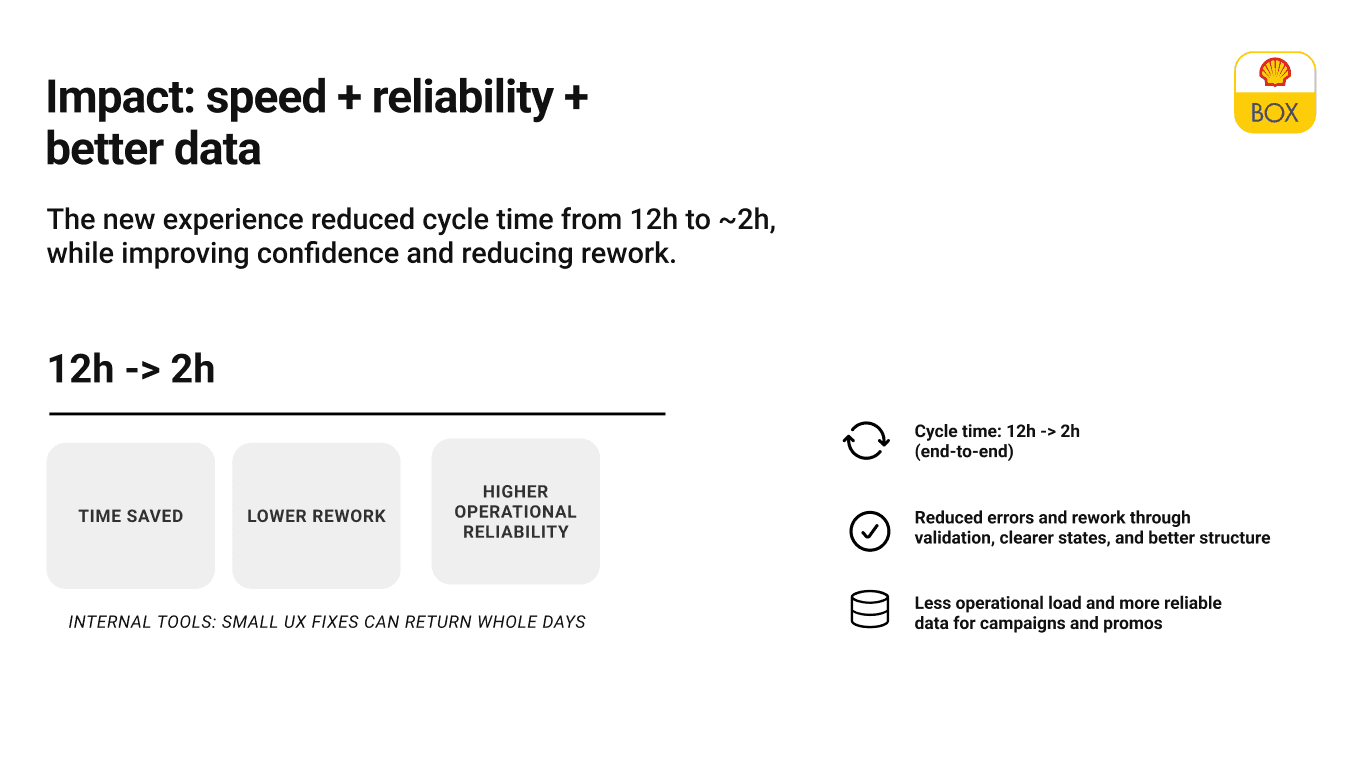
08 — Impact
12h→2h
operational cycle time
−83%
cycle time reduction
→
Less rework and manual verification
→
Faster campaign operations
→
Higher confidence in system output
The redesign reduced manual effort, removed repetitive work, and made the workflow faster and easier to trust.
09 — Reflection
"Internal tools may not look glamorous, but they can create enormous operational impact. This project reinforced a simple principle: observe the real work before redesigning the interface."
Tom Oliva
Product Designer UX/UI · Buenos Aires, Argentina